



Majlis Ugama Islam Singapura
Friday Sermon
1 May 2026 / 13 Zulkaedah 1447H
Youth and Today's Challenges
Zumratal mukminin rahimakumullah,
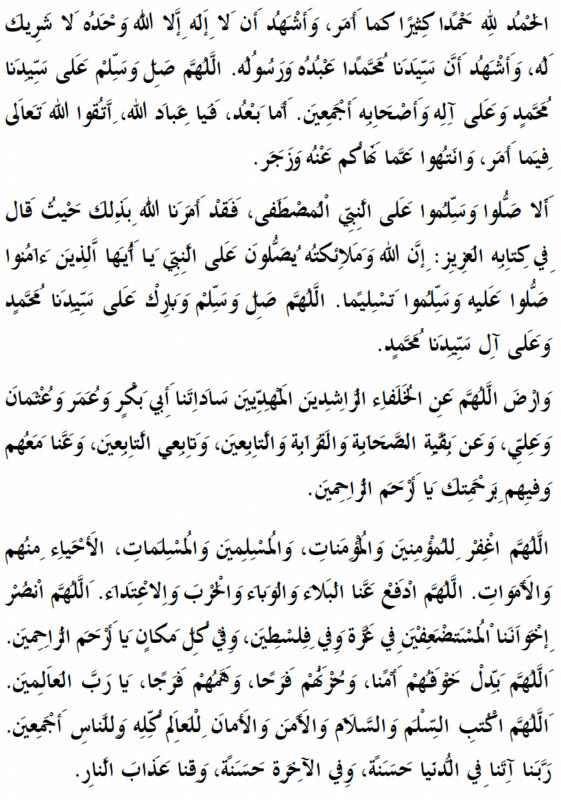
Fear Allah s.w.t. at every moment and in every circumstance. Obey all His commands and refrain from all His prohibitions. May we attain success in this world and the Hereafter. Amin, ya Rabbal ‘Alamin.
Dear brothers, especially the youth,
In Surah Al-Kahf, Allah s.w.t. records the story of a group of young men who remained steadfast upon faith, even while surrounded by an environment that challenged their belief. Allah s.w.t. says in verse 13:

Which means: “We relate to you (O Muhammad) their story in truth. Indeed, they were youths who believed in their Lord, and We increased them in guidance.”
Scholars of tafsir observe that although the term “fityah” (youths) had already been mentioned in earlier verses, it is repeated here to highlight their distinction – not merely as ordinary young people, but as youths whose hearts were filled with faith in Allah.
Al-Imam Ibn Kathir explains that the youths of Ashabul Kahf were more open to evaluating and accepting the truth compared to those older than them. Though they lived in a time that tested faith, they remained firm and principled, putting in effort while placing full reliance upon Allah s.w.t.
Therefore, Allah does not measure a person by age, but by a sincere heart and a soul that submits to His guidance. The story of the youths of Ashabul Kahf stands as proof that Allah elevates ranks, preserves faith, and honours those who truly recognise their Lord – even if they are of young age.
Blessed brothers,
The context and challenges faced by today’s youth are much different from what we observed 15 or 20 years ago.
Today, we see many positive achievements that reflect the capability and potential of our youth across many fields. At the same time, we cannot deny that there remain social issues and challenges that sometimes involve them.
Why is this so, dear brothers? It is because the world has become increasingly open. Global norms – both positive and negative – now spread without boundaries. Information travels rapidly through digital media.
The challenges faced by youth today reflect even greater challenges that may affect the whole of society tomorrow. For today’s youth are tomorrow’s parents, leaders, and guardians of the next generation.
Here, the story of the youths of Ashabul Kahf speaks to us with profound meaning. They too once stood amid trials and pressures that shook faith. Yet those challenges did not weaken them; rather, they strengthened their resolve.
My dear brothers,
Today’s khutbah calls us to shape the resilience in Muslim youth through three guiding principles:
First: Evaluating ethics and morality through the lens of Islam
Today, moral values are often measured by individual rights and societal perceptions. Freedom is emphasised, yet responsibility, trust, and dignity are often overlooked. Consider how social norms today – partly shaped by media – view sexual relations outside marriage mainly through the lens of freedom and consent, without due regard for their long-term impact on individuals, families, and society.
Islam approaches this matter holistically. It considers long-term maslahah or welfare, such as preserving lineage, personal dignity, and societal morality. This is why Islam permits relationships between men and women only within the bond of marriage as decreed by the Shariah. This is a form of protection rooted in Allah’s mercy towards His servants.
Therefore, not everything accepted by the masses aligns with divine guidance. Islam does not deny rights, but balances them with responsibility and wisdom, in pursuit of seeking Allah’s pleasure.
Second: The courage to choose truth over what is normal
One of our greatest trials today is when wrong becomes normal. When something becomes widespread or common, we may stop questioning it. For example, negative habits such as using vulgar speech and obscene language. What is more concerning is when such behaviour is accepted as normal and perceived as not needing to be corrected, when in truth, we know that it is wrong and sinful.
Dear brothers, Islam teaches that truth is not measured by numbers. The excuse that “many people do it” does not determine whether it is right or wrong. Allah says in Surah Al-Jathiyah, verse 18, that which means: “Then We put you (O Muhammad) on a clear path of the religion, so follow it and do not follow the desires of those who do not know.”
Thus, a believing youth – like the youths of Ashabul Kahf – must be able to distinguish between truth and falsehood. Staying grounded in this principle differentiates those who are swept away by their surrounding pressures from those who remain rooted in religious guidance.
Third: Choosing the right companions on our journey towards Allah
Dear brothers, we are shaped by our environment – by those we spend time with, and by the voices that enter our hearts. The Prophet s.a.w. reminded us: “A person follows the way of his companion, so let each of you look at whom he befriends.” (Narrated by Ahmad)
Today, our circle of companionship and influence does not include only those we meet physically, but also the voices and figures we engage with on social media. There are also external values which may influence us subtly, such as through digital influencers. Every click, every view, every follow leaves an impact upon the heart and shapes our thinking. So let us be wise in choosing companions and a circle of influence which draws us closer to Allah s.w.t.
Honoured congregation,
Indeed, the nurturing of resilience in youth does not rest solely upon their shoulders. It is also a trust upon the older generation to guide them with wisdom and compassion.
Let us strive together to nurture a generation of youth who are firm in faith, clear in principle, and wise in facing the challenges of their time. May Allah s.w.t. guide us all to the path that earns His pleasure. Amin, ya Rabbal ‘Alamin.

Second Sermon